Be yourself; Everyone else is already taken.
— Oscar Wilde.
This is the first post on my new blog. I’m just getting this new blog going, so stay tuned for more. Subscribe below to get notified when I post new updates.
Be yourself; Everyone else is already taken.
— Oscar Wilde.
This is the first post on my new blog. I’m just getting this new blog going, so stay tuned for more. Subscribe below to get notified when I post new updates.
A Matter of Life and Death is a sentimental post WWII film designed to console an audience that has most likely lost a lot of loved ones. This is a film following the life of Peter Carter (David Niven) English RAF pilot who attempts suicide from jumping out his plane without a parachute as it’s on fire about to crash. During this deciding moment, he is on a call talking to an American woman June (Kim Hunter). It is then discovered that Peter had survived the jump and stumbles upon June by sheer luck, falling in love. He then wants a second lease on life and to do this he must fight his case in a celestial court.

I would like to begin by saying, this was my first viewing of the film, and I loved it. What I loved most about this film was the cinematography. Never in my life have I seen cinematography with such brilliant use of colour. Throughout the film there’s this swing back and forth between black and white and technicolour. The accuracy within each shot as well, really is otherworldly, it’s brilliant. There is such stunning and creative mise-en-scene throughout the film as well. For example, one scene during the ending of the film presents everyone from the court on the celestial staircase, coming down from heaven to address June, on her love for Peter. During this scene there’s this perfect representation of heaven and earth. This shot in particular makes great use of a stylistic feature frequently used throughout the film, this being the use of freeze frames. This is a great feature, symbolising the stop of time and a link between life and death. The film really beautifully presents this, especially during this scene in which we see the surgeons doing surgery on Peter, except Peter isn’t in the bed he’s standing in full uniform in position to the staircase. At this point there has been a request to freeze Peter to allow for June to inadvertently save Peters life and ultimately save their relationship, for love is more powerful than the law of eternity.
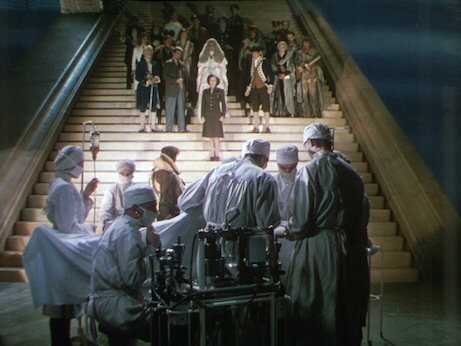
Another aspect of this film that has me singing its praise is the level of symbolism throughout the film. How the directors constructed the link between heaven and earth through the utilisation of a freeze frame is just perfect. Another example of symbolism I loved in this film is the representation of the fight for life against death. Through the use of surgery and court the film creatively presents the idea of a fight for a second chance of life. We have the surgeons fighting to keep him alive down on earth, creating the idea they are in control of his life at that time, but really there is a celestial court case deciding on whether Peter gets his second lease on life. In a sense the surgery is used as a microcosm to represent the court case as it encapsulates the idea of the fight between life and death.

There are aspects of this film that I have criticism towards this being the over utilisation of melodrama as a representation of romance and Peter and Junes love, but I will push that under the rug considering the time it came out. However, overall that is my only real criticism for this film as a test of time, really, I loved it.
In conclusion, this is a sentimental film designed to console its audience. I think it’s incredibly hard to dislike this film for the sheer creative and awe-inspiring level of cinematography among its also brilliant story line and philosophical underlining. I would highly recommend this film to anyone at all, I have no doubt in my mind that this is a film everyone would enjoy.
9/10
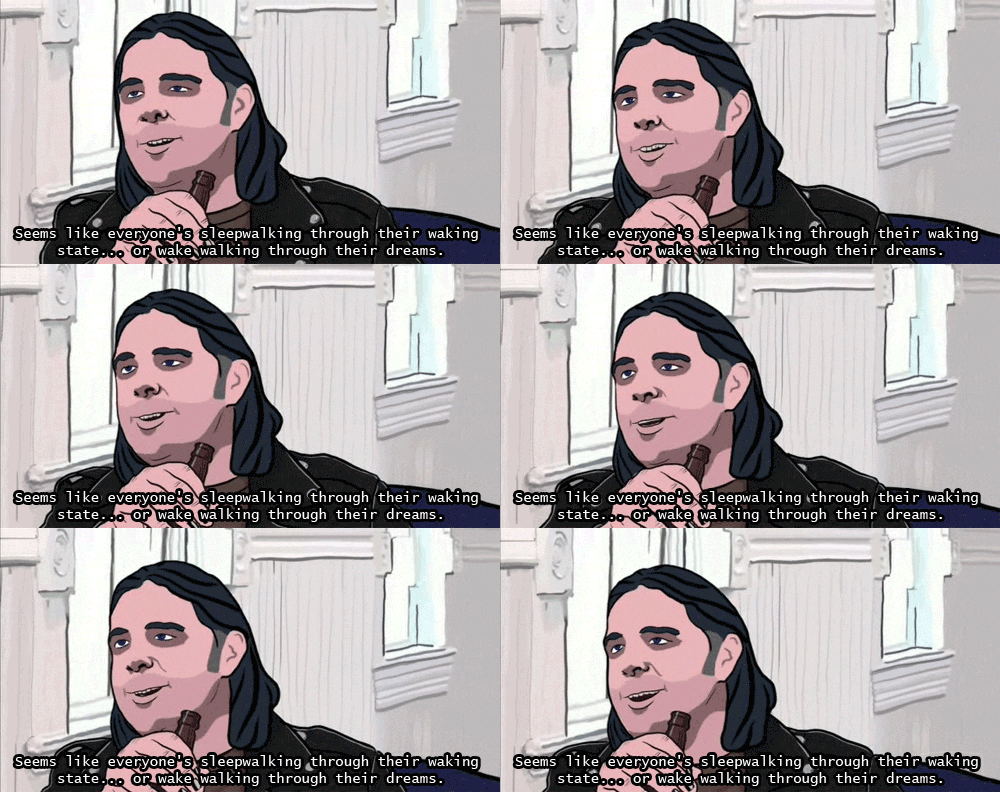
For a long time, I’ve been pondering the idea of film criticism. Film is a passion of mine and one that I live for, but with such an abundance of film in the world I couldn’t decide where to begin. So, I thought long and hard considering many films that I would love to review, but for my first post, I just couldn’t come to a conclusion. I would come up with idea after idea, ultimately never amounting to anything. So, feeling like a mug I gave in, I just could not find it in myself to do it. Then one evening, I thought, screw it. That’s where I’ll begin, the film I came to decide on was Richard Linklater’s independent film Waking Life.
Waking Life is hard to define as a film. It’s genre is of a peculiar nature whether it has a genre is debatable in itself, if it’s fictional is debatable in itself as well. If I were to explain what this film is I would say it’s a construction of overlapping narratives, genre conventions and ideas. On one part it’s a film that follows a nameless protagonist through a series of lucid dreams eventually becoming trapped and struggling to wake up. What starts off as a pretty interesting, mentally stimulating dream slowly drifts off in to nightmare territory exploring ideas of limbo and ultimately becomes a question of mortality for the protagonist, he becomes uncertain whether he’s alive or not. However, it’s unfair to strictly confine the film to this narrative, cause the film could be considered to be a number things such as a documentary on lucid dreaming, philosophical movements such as existentialism, for the large majority of the film it’s just interviews with professors, philosophers, actors, writers, real people, it is also a meditation on film as a format at the exact same time whilst also being an animation. I would say ultimately this film is indefinable it’s hundreds of things, what, is hard to say.
Thematically, there is so much I love about this film, one example is the way Linklater blurs the line between fiction and reality, there is this consistent teetering between the two and not just in the film world. The film becomes meta-fictional and not necessarily in the sense the film addresses the audience because it doesn’t, not even in the sense that it’s aware that it is a film. It is metafictional, yes, in the sense that the protagonist is fully aware that he is lucid dreaming. For example, there’s one scene where he flicks the light switch on and off and the light doesn’t turn off. This is one of the rules of the dream world you cannot mess with light. So, the fact the light will not turn off tells the protagonist he is dreaming. Another example, is the way the numbers on the clocks in the film are jumbled. This is because in the dream world time is unknown. So, there is no doubt that the protagonist knows he is inside a dream. There are also a few other characters who are aware they are also in a dream, whether they know they’re in his dream is unknown. This also tells the audience the film is set inside of a dream. However, it doesn’t tell you at one point where the dream begins, I mean what’s the paper fortune teller about in the beginning? Who really is the protagonist? are we actually inside his mind? or is he a representation of consciousness and really we have no clue who the character is? Or even who’s dream we are in. We have an idea, we could guess, but when we break into the intricacies it becomes hard to say. I think this is the beauty of the film, Linklater taunts the audience he doesn’t give answers, he gives an answer whether that is the answer is 100% debatable. It also brings to mind another philosophical question where is the film set in space and time? We know it’s set in a dream whose dream we do not know, what reality the film set in then becomes another question. Is it set in the audiences reality, because it deals with real people, real philosophers, but it also makes reference to other Linklater films such as Slacker (1990). Structurally the film is very similar to slacker and [SPOILER ALERT] encapsulate a theory in which is expressed in Slacker. During the taxi scene in which Linklater, 1. talks about a dream, 2. talks about it being an extremely vivid dream, 3. talks about someone being hit by car in all HIS dreams, 4. talks watching TV and reading in his dream, 5. talks about hitchhiking instead of taking a cab and 6. he talks about this ‘beautiful woman’ talking to him at the payphone , this all takes place in Waking Life. However, the part that strikes me the most applies to this quote from Slacker:
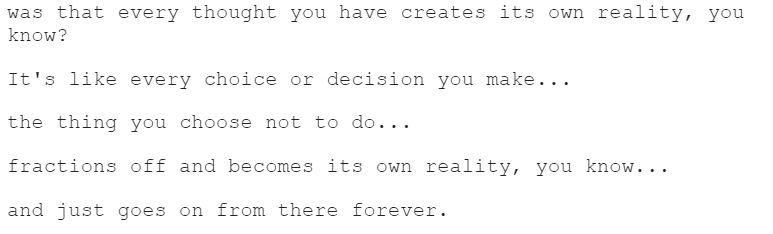
This idea Linklater expresses in his debut film is utilised throughout Waking Life, especially the quote from Slacker in which Linklater states that each reality thinks of this reality as the only reality. So, does that mean Slacker and Waking Life share the same reality? Are they both set in the same universe? Are both these films occurring at the same time? Is it actually 1990 in Waking Life? Is Slacker a dream in itself? Because [SPOILER ALERT] someone gets hit by a car in that film too, but the idea both these films share the same reality can’t be true because Linklater is in the car that picks up the protagonist in Waking Life. What if the protagonist is a representation of a younger Richard Linklater in Slacker? In which case he made a different decision he got a train instead of a bus, the car who picks him up arrives before the cab. What if this is one of the dreams Linklater had on the coach? These questions are completely in the air there is no possible answer.
Another question that arises is the idea that does Linklater have a filmverse? are Slacker and Waking Life set in the audience world or is there a fictional world constructed here? Because whilst Waking Life deals with real people, philosophers etc. it does also feature a scene in which characters from a previous film Linklater had made called Before Sunrise appear and talk about the idea that Celine’s (one of the characters in the scene) life could also be a dream, as she constantly feels she’s an old woman who has just died watching over her entire life, this sprouts even more questions: Is this dream actually one of celines? Has the protagonist seen Before sunrise and is dreaming about it? In which case is the film set in the audience world? Or is this another narrative? again it can’t be answered the film never explains itself it just constantly blurs this line between reality and fiction. This scene also further explores a theme that is previously explored throughout the film and further becomes a main theme throughout, this being a debate on existentialism.
Throughout this film a debate on existentialism is consistently had whether it being on reality, are we awake or asleep? where are we in time and space? are we actually dead? This is obviously a debate much larger than the film itself, it’s an age old debate exploring meaning and purpose, it also in application to the film not just narrative wise it’s a debate that proposes an existential theory on film, questioning it’s purpose, is it purely a story telling format, or is to present a moment, why do we enjoy film?
The film also theoretically argues ideas on Generation Z, this being an almost lost generation, set up for so much hope by the hippie generation but met reality with a lack of meaning. This could be related to when the protagonist is asked whether he is a dreamer in which he replies he is, he’s told there are few dreamers around, which insinuates a light of hope for Generation Z who were unsure of where they were going. There is this constant desire throughout the film to ignite meaning and power thus could be the subconscious of the character telling him to find hope in a meaningless world.
There is also a debate on existentialism and death and this realm of the dead as yet again another reality, a dream within the dream told by a character who is unaware he is in a dream and has also previously been in the dream. This scene in particular also brings to light ideas on time and where we actually are in time. Is it actually a different year all together and this almost time keeper is constructing an illusion we exist in another year? Another reality? Or does time not actually exist? Do we live in one moment and that is constant? There is also during this particular scene this introduction of religion in regard to time and existentialism and eternity. Is time one in eternity? Is time just an invitation by God to become one with eternity and initially enter heaven and we just constantly say no not yet? Is time just accepting death? or of course is it all just a dream?
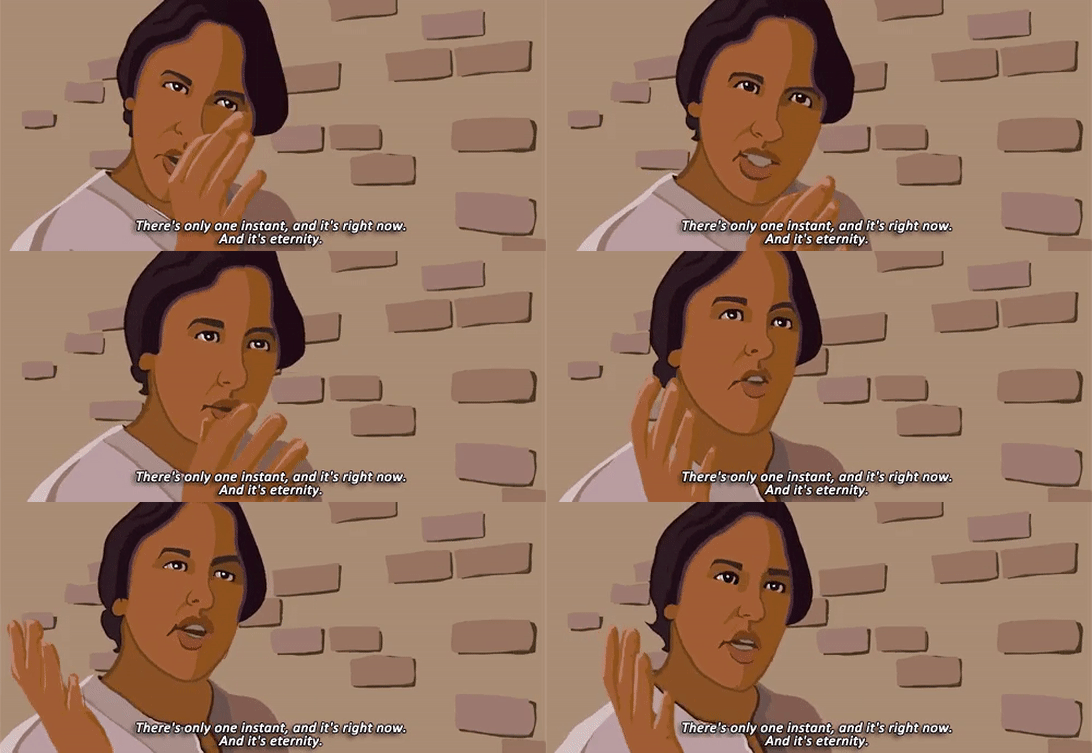
In conclusion, this is a favourite of mine, a film I find to be very intellectually stimulating. If questions with no answer, debates on ideas bigger than film, bigger than life itself is your thing, if you enjoy philosophy, or even just enjoy linklaters work, this is a film I highly recommend.
10/10
This is an example post, originally published as part of Blogging University. Enroll in one of our ten programs, and start your blog right.
You’re going to publish a post today. Don’t worry about how your blog looks. Don’t worry if you haven’t given it a name yet, or you’re feeling overwhelmed. Just click the “New Post” button, and tell us why you’re here.
Why do this?
The post can be short or long, a personal intro to your life or a bloggy mission statement, a manifesto for the future or a simple outline of your the types of things you hope to publish.
To help you get started, here are a few questions:
You’re not locked into any of this; one of the wonderful things about blogs is how they constantly evolve as we learn, grow, and interact with one another — but it’s good to know where and why you started, and articulating your goals may just give you a few other post ideas.
Can’t think how to get started? Just write the first thing that pops into your head. Anne Lamott, author of a book on writing we love, says that you need to give yourself permission to write a “crappy first draft”. Anne makes a great point — just start writing, and worry about editing it later.
When you’re ready to publish, give your post three to five tags that describe your blog’s focus — writing, photography, fiction, parenting, food, cars, movies, sports, whatever. These tags will help others who care about your topics find you in the Reader. Make sure one of the tags is “zerotohero,” so other new bloggers can find you, too.

 worldoffilm